
Monday, November 25, 2019

Tuesday, October 29, 2019
Seasonal Surprises!
The word
“seasonal” usually refers to some aspect of summer, fall, winter or
spring.
In this context I’m referring to
the GROWING SEASON—that time of year gardeners eagerly anticipate in
springtime, and usually finish in October here in Wisconsin. Let me share a few seasonal surprises
encountered in GROWING SEASON 2019:
Surprise
#1: During summer I learned a destructive
caterpillar infestation can destroy foliage on an American cranberry bush (Viburnum
trilobum) and a redtwig dogwood (Cornus sericea ‘Isanti’) in just a few
day! I never encountered this grey and
yellow caterpillar before this summer; it is evil and apparently is attacking
deciduous shrubs (mainly the Viburnum genus) throughout southern
Wisconsin.

Surprise
#2: Since I am fortunate to have a plethora of
pollinators visiting my garden, the zucchini harvest is usually abundant. My preference is harvesting zucchini when fruits
are 4” – 8” in length. Gardeners know
that sometimes a large zucchini is lurking beneath the foliage—well camouflaged—
but I never realized one fruit could grow to fourteen pounds… surprise!


Surprise
#3: A friend shared some seeds with me for an
annual producing yellow and orange blooms; she did not know its name. I grew these seeds in a full sun location and
learned they are sulphur cosmos (Cosmos sulphureus.) They grew four feet
tall and flowered all summer, attracting various pollinators the entire time. As seeds formed, I collected them for next
year; sulphur cosmos was a sweet surprise!
Surprise
#4:
Japanese beetles are a

 Surprise
#5: Waking up this morning to an inch of fresh
SNOW on the grass! October 29 is the
earliest snowfall I have witnessed in my lifetime… although it provides a bit of
nitrogen for turf grass and other plants, it is not a pleasant surprise.
Surprise
#5: Waking up this morning to an inch of fresh
SNOW on the grass! October 29 is the
earliest snowfall I have witnessed in my lifetime… although it provides a bit of
nitrogen for turf grass and other plants, it is not a pleasant surprise.
Planning and
hoping for an interesting and fruitful GROWING SEASON in 2020…
M. Lynn
Schmid, Certified Master Gardener
A.A.S. Landscape/Horticulture/Arboriculture
A.A.S. Landscape/Horticulture/Arboriculture
Monday, September 23, 2019
Falling for Fall Flowers
 Spring
flowering bulbs provide relief after an intense winter… summer blooms are bold
and beautiful… but by mid-September,
I can’t help falling for fall flowers!
Spring
flowering bulbs provide relief after an intense winter… summer blooms are bold
and beautiful… but by mid-September,
I can’t help falling for fall flowers!
Thriving ornamental
grasses sway in gentle breezes. Ears of corn
have been harvested, but who can resist bundling their tall, dry stalks and
using them for outdoor décor?

Hydrangea blooms can be allowed to partially
dry in place, and later can be pruned off and air dried. (These dried plumes look amazing displayed in
a basket lined with burlap or lace, or as accents in a holiday bouquet.)

This season’s
“star” in my backyard was the lantana shown here. It flowered constantly, spring through
summer—no deadheading needed. An added
bonus, Japanese beetles never bothered the foliage, flowers nor fruit!
This lantana deserved to be included in my
autumn décor, so I placed it in a container with German ivy, white geraniums
and a white pumpkin.
(In Wisconsin
lantana is sold as an annual, but my friends in Georgia grow the perennial
shrub variety—it can grow six feet tall, and it produces bushels of blooms!)
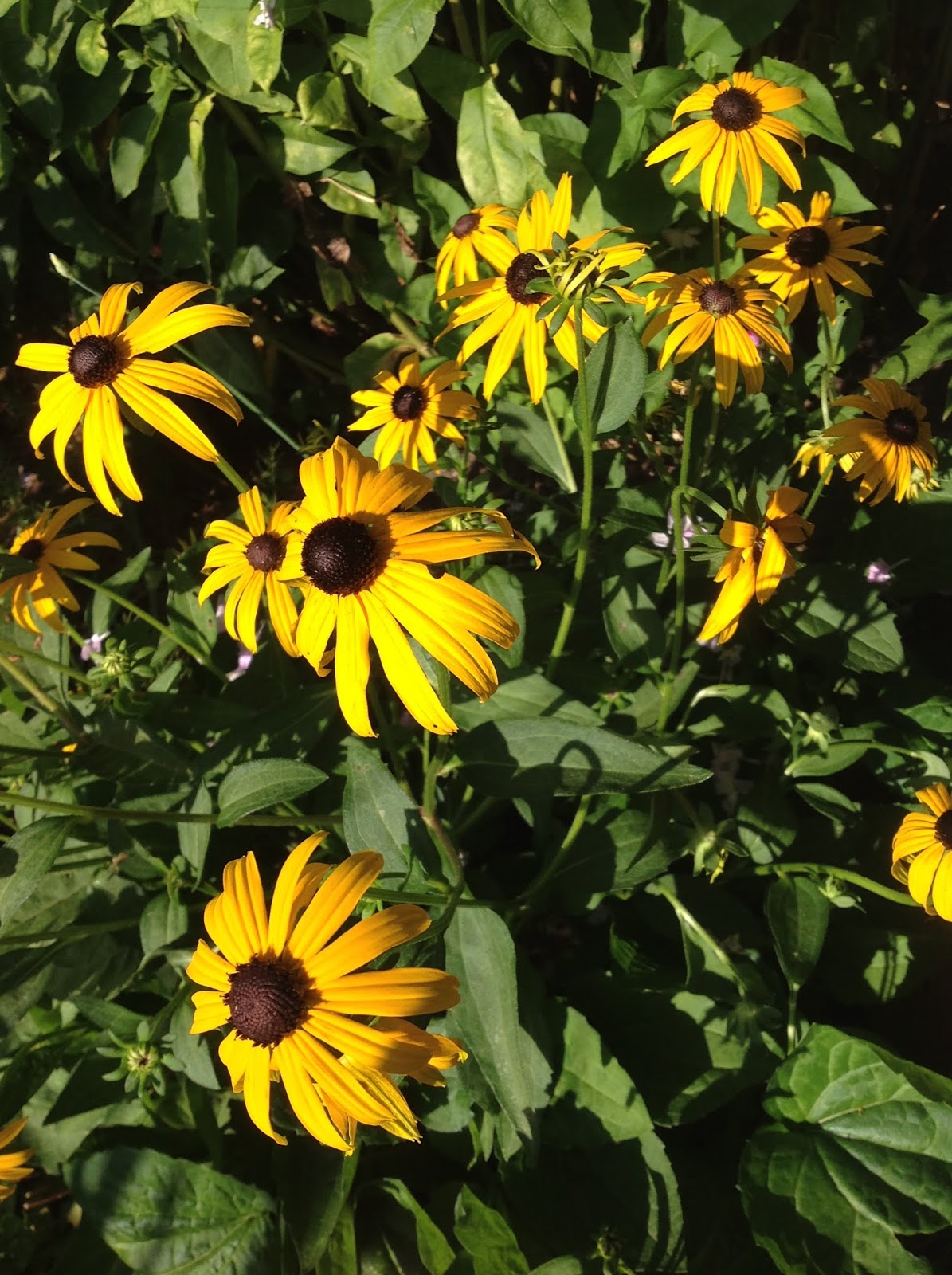
Rudbeckia (black-eyed Susan) can be disease
prone since it is in the Asteraceae family—am grateful the small patch of Rudbeckia
in my garden seems happy.
Foliage is clean and green, even in mid-September. The vivid yellow-gold petal color is truly
compatible with autumn décor.
Our days are
a bit shorter; our night time temps, a bit cooler—fall is nearly here!
M. Lynn
Schmid, Certified Master Gardener
A.A.S. Landscape/Horticulture/Arboriculture
A.A.S. Landscape/Horticulture/Arboriculture
Monday, August 26, 2019
Midsummer Daydreams (in purple & pink!)

On the
warmest summer days in Wisconsin, people enjoy daydreaming while watching puffy
clouds change forms as they cross a deep blue sky. Daydreams are a pleasant
past time, and are different for each individual. My daydreams take form in the flowers growing
in our garden in the middle of summer. I’m
sharing a few of my favorite blooms that provided pleasure in recent months…
this is what dreams are made of for a gardener!
Clematis
‘Etoile violette’
These clematis vines are perennials that require a support structure so they
can grow tall and strong; they are quite hardy and perform well in USDA Zones 4
– 8. Deep purple blooms are plentiful
each summer, and diseases don’t seem to bother them. Although I had several hundred Japanese
beetles munching on my plants this summer, they never seemed to bother flowers
or foliage on this clematis.
HINT:
Clematis enjoy full sun, but need some shade to protect their tender root
zone. I placed a rectangular container
filled with annuals to provide a “shade pocket” for the root zone; this worked
well, the plant thrived.) ‘Etoile
violette’ is an old cultivar—developed more than 120 years ago—but it looks young
each summer!
 Astilbe chinensis ‘Vision in Pink’
When I’m in the mood to daydream in PINK, this plant is a
vision to behold. Flowers hold their
soft pink color for a few weeks, and then I like to deadhead them to dry. When
fully dried, these spikes can be spray painted and used in floral arrangements;
however, they are lovely in fresh arrangements as well. Astilbe is typically a shade lover, but where
it grows in my garden it gets full morning sunlight; it is happy there.

Phlox paniculata
This
prolific bloomer is tall garden phlox, and the soft lavender color beckons to
swallowtails and monarchs throughout summer months. It is a tenacious plant that doesn’t need
pampering; simply deadhead expired blooms a few times in summer, and cut it
back to four-inch height in fall. Its
foliage is prone to powdery mildew, but thru midsummer this season, it has not
appeared.
Since mildew/mold spores can
winter over in foliage, I do NOT place dead stems in our compost bins. Tall garden phlox blooms nearly six weeks in
midsummer, and is rated USDA Zones 4 – 8.
Midsummer
daydreams are a very good thing… I hope YOU photographed some memorable and
beautiful flowers to create your own special daydreams!
M. Lynn
Schmid, Certified Master Gardener
A.A.S. Landscape/Horticulture/Arboriculture
A.A.S. Landscape/Horticulture/Arboriculture
Sunday, June 30, 2019
Peonies: Pretty & Pink
Warm June
days brought bold-colored blooms to my garden… but of all the blooms I enjoyed,
none compared with the biggest and boldest of all: PEONIES!
 Since I do
small space gardening on a quarter-acre property, I can’t often accommodate
plants with a huge footprint, nor plants that spread aggressively. But the genus Paeonia offers
several well-behaved cultivars and deserves a dedicated space in my garden. It expands gradually over time, but remains in
a tight clump.
Since I do
small space gardening on a quarter-acre property, I can’t often accommodate
plants with a huge footprint, nor plants that spread aggressively. But the genus Paeonia offers
several well-behaved cultivars and deserves a dedicated space in my garden. It expands gradually over time, but remains in
a tight clump.
For years I have
enjoyed the hot-pink petals of cultivar ‘Raspberry Ice’ which opened its first
blooms on June 17 this year. (Although
the fresh growth of peonies usually emerges in April, the blooms typically
appear in June.) Now at the end of
June, many of those bodacious blooms have expired. It is a short—but dramatic—engagement,
performing every year. (Repeat
performance, expected next year in mid-June!)


Gardener’s
tips: Suggest placing a wire support cage over each
plant while stems are just a few inches long; it is awkward to install a
support cage after foliage has formed. If you wish to divide a large plant,
September is ideal in Wisconsin. Dig
deeply around section to be transplanted; plant in rich organic soil in sunny
area. Maintain same soil level around
stems—do not add too much soil on top.
M. Lynn
Schmid, Certified Master Gardener
A.A.S. Landscape/Horticulture/Arboriculture
A.A.S. Landscape/Horticulture/Arboriculture
Friday, May 17, 2019
True Blue: Siberian Bugloss
“True Blue” is an old expression often used to
describe a lasting friendship or relationship.
Merriam Webster website tells us “true blue” can be an adjective describing
someone who is extremely loyal, devoted or dedicated to a person or a
cause.
There is additional information
on the significance of flowers in the color BLUE… these blooms may signify
qualities like trust, long term commitment, desire and love. How lovely
that the tiny blooms on the perennial Siberian Bugloss are “true blue”
(AND beautiful!)
Early May in Wisconsin offers gardeners pockets of color in
the garden; colorful spring daffodils and tulips remind us that winter weather
MIGHT actually be finished for the moment.
But in early MAY most perennial plants are pushing new growth and foliage—not
flowers.
One exception: Siberian Bugloss, which flowers
perfectly in a partial sun environment.
The individual flowers are teeny, but a vivid shade of BLUE! Away from direct sunlight, the dainty blooms may
appear to be a fluorescent BLUE.
 Siberian Bugloss is a terrific companion planting—shown
here paired with Solomon’s Seal in our backyard. In our front garden Siberian Bugloss
complements Berberis thunbergii
‘Orange Rocket.’ (This compact shrub is
rated as hardy in USDA Zones 4 – 9, and pushes coral colored foliage in spring;
later this foliage shades to green, and in autumn—a deep burgundy.)
Siberian Bugloss is a terrific companion planting—shown
here paired with Solomon’s Seal in our backyard. In our front garden Siberian Bugloss
complements Berberis thunbergii
‘Orange Rocket.’ (This compact shrub is
rated as hardy in USDA Zones 4 – 9, and pushes coral colored foliage in spring;
later this foliage shades to green, and in autumn—a deep burgundy.)

Brunnera macrophylla is described as a
clump-forming, shade-loving woodland garden herbaceous perennial, but it
thrives in a part-sun environment as well.
Apparently, it is distasteful to rabbits and insects since I have never
observed plant damage from any pests. It
thrives in well drained, rich, organic soil.
Rated as a USDA Zone 3 – 8 plant, it can
tolerate a wide range of temperatures.
Purchase a plant or two of Siberian Bugloss soon, and next
spring, you’ll be enjoying those dainty “true blue” blooms!
M. Lynn Schmid,
Certified Master Gardener
A.A.S. Landscape/Horticulture/Arboriculture
A.A.S. Landscape/Horticulture/Arboriculture
Sunday, May 5, 2019
Think... GARDENING!
Think…
GARDENING!
As we move into MAY and winter weather releases its grip on
Southeastern Wisconsin, plant lovers here are eager to work their fingers
through the soil on a soft, sunny day. They are anxious to plant a few
cool-weather veggie seeds (like radishes and peas) to officially commence our
2019 growing season.
Veteran
gardeners are so ready to begin the plant-nurture-harvest season once again… but what about those who are novice
gardeners?
Those individuals
might appreciate a few guidelines from an experienced gardener—suggestions that
will help ensure success as these new gardeners accept the challenge of growing
edibles and ornamentals this season.
Here
are some thoughts to encourage a new or novice gardener:
Think SMALL … when you select a new garden space. Soil prep, weed and turf removal for a large
area can be overwhelming for a new gardener.
Think GARDEN ART… a few well placed pieces will enhance;
too many pieces may appear tacky (less is
more; you’ve heard this before!)
Think SEEDS… not every plant needs to be purchased in a
plastic pot. You can purchase seed packets, or participate in a seed exchange
with friends. (Some libraries also offer participation in seed exchanges—check
your library.)
Think SWAPPING… early spring is usually ideal for dividing
perennials, especially plants in the Hosta
genus. You give a portion of your
perennial to a friend, and they provide you with something from their plant
collection.

Think LOCAL… perennials grown in or near Wisconsin are more
likely to transplant successfully and should thrive in our soils and climate.
Think BUTTERFLIES… these beauties will visit your yard more
often if you “invite” them with tempting, colorful blooms. (Butterflies have distinct preferences,
whether they are feeding on nectar or laying eggs. Look up a few butterflies on line and plant some
of their favorite flowers to increase chances of butterfly sightings in your own
garden.)
 Think BLOOM TIMES… select annuals and perennials that bloom
at various times, keeping your garden vibrant and attractive, spring through
fall.
Think BLOOM TIMES… select annuals and perennials that bloom
at various times, keeping your garden vibrant and attractive, spring through
fall.
Think RIGHT PLANT, RIGHT PLACE… sun lover or shade
lover? rich, organic soil? gravely, well-drained
soil? Choose wisely to keep plants happy.
Think SUCCESS… enjoy learning new skills, have confidence
in your abilities!
M. Lynn Schmid,
Certified Master Gardener
A.A.S. Landscape/Horticulture/Arboriculture
A.A.S. Landscape/Horticulture/Arboriculture
Subscribe to:
Posts (Atom)